



Your biggest AppSec blind spot is the code you never wrote.
Attackers don't target your code. They target what you install: packages, MCP servers, IDE and agent extensions. SafeDep blocks malicious packages at every entry point, before they run.
No credit card Free forever for individual use  Start with GitHub
This isn't theoretical.
We find it in real time.
SafeDep analyzes every package published to the major registries, around the clock. Our research team publishes the breakdown, often before the ecosystem has an advisory.
 npm
npm  Mini Shai-Hulud Strikes Again: 317 npm Packages Compromised One compromised maintainer account published 637 malicious versions. 317 packages
  PyPI
PyPI  Malicious litellm 1.82.8: Credential Theft and Persistent Backdoor A .pth file triggers credential theft the moment the package installs. AWS + K8s secrets npm Shai-Hulud 2.0 npm Supply Chain Attack Technical Analysis Self-replicating malware in zapier-sdk, @asyncapi, posthog and @postman. 25,000+ repos
 - packages scanned
- 20M+ packages scanned
- components analyzed
- 500K+ components analyzed
- projects secured
- 5000+ projects secured
- avg detection lead
- 14hr avg detection lead
Malicious code doesn't break in.
It gets installed.
Third-party code arrives at every hand-off in your pipeline, from a developer's terminal to an org-wide registry. Each arrival is an execution, and none of it was reviewed by anyone on your team.
Developer machine
AI coding agent
Repository / PR
CI/CD pipeline
Registry / org-wide

SafeDep guards the same five stages.
One policy, enforced everywhere the component travels, so it is inspected before it runs, merges, builds or spreads across the org.
Pick a layer.
See what SafeDep does there.
Credential theft, reverse shells, data exfiltration. These are purpose-built attacks, not bugs a vulnerability scanner can match against a database. Every screen below is the real product.
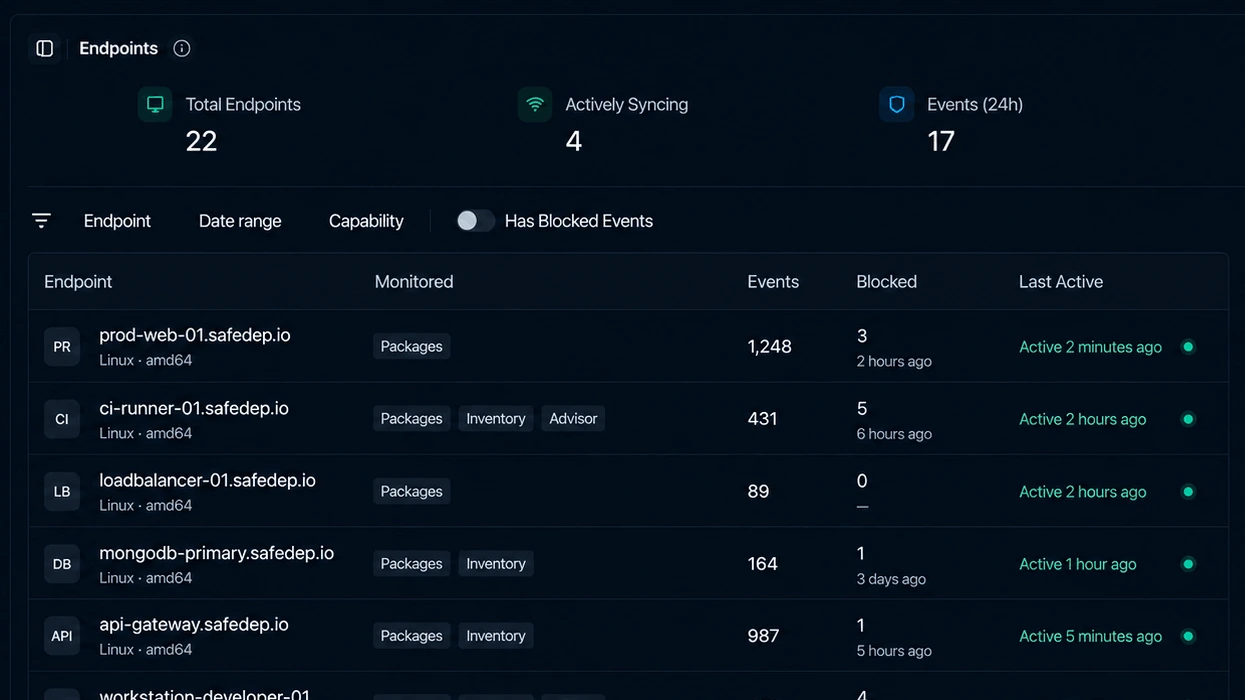
Block the install, on every machine
SafeDep sits in front of npm, pnpm, pip, uv, bun and other package managers and blocks malicious packages at install time, before any post-install script runs. Every decision lands in one fleet view, alongside a live feed of what was just blocked and where.
- Refused at install time, not flagged next week
- Laptops, CI runners and servers in one view
- Live feed of blocked packages, per endpoint
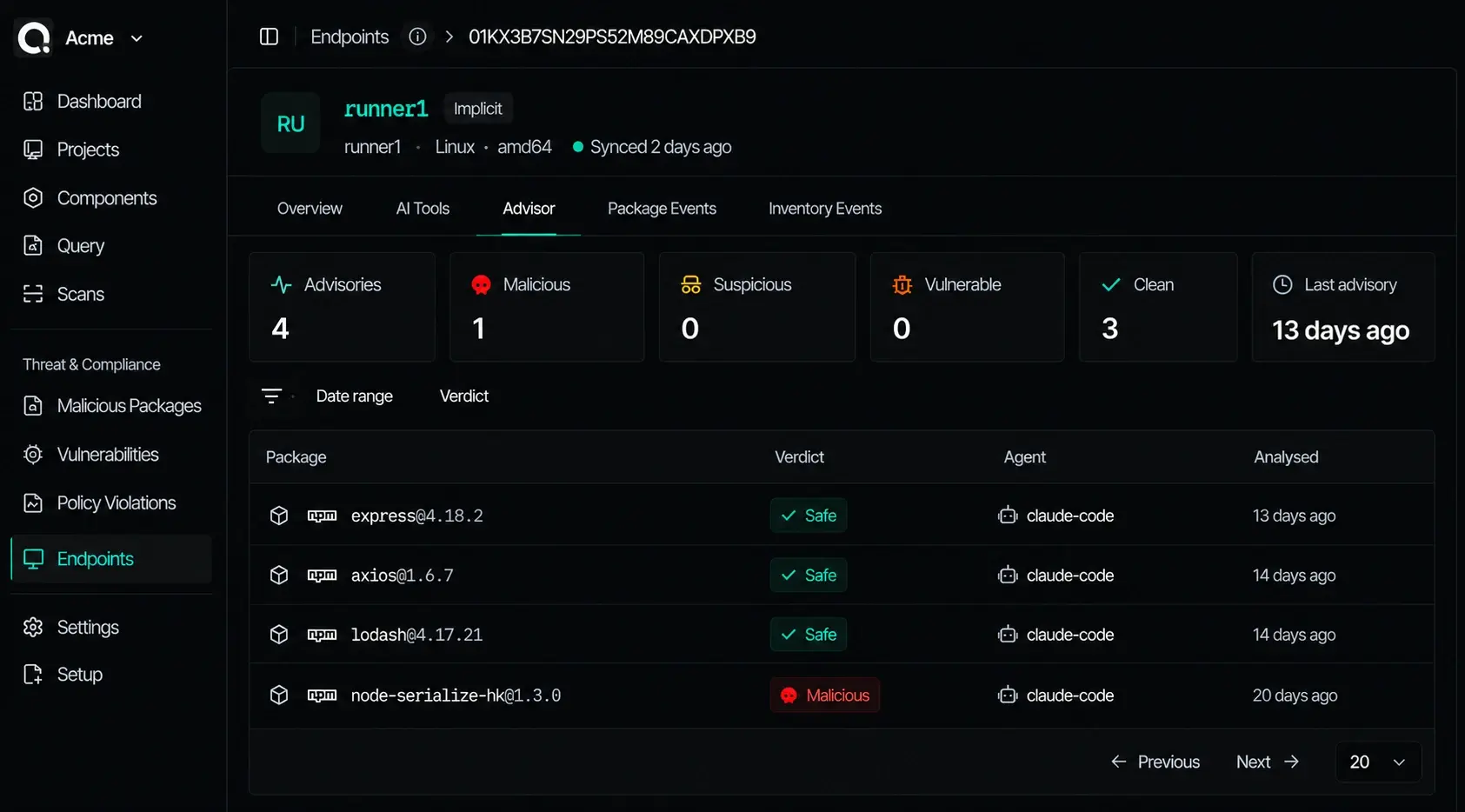
Every package your agent pulled, with a verdict
SafeDep MCP checks each package an agent wants before it installs. The advisory trail shows which agent asked for what, so a malicious pull is attributed rather than anonymous.
- A verdict per package, attributed to the agent
- Works with Claude Code, Cursor and Windsurf
- Malicious packages refused, not merely flagged
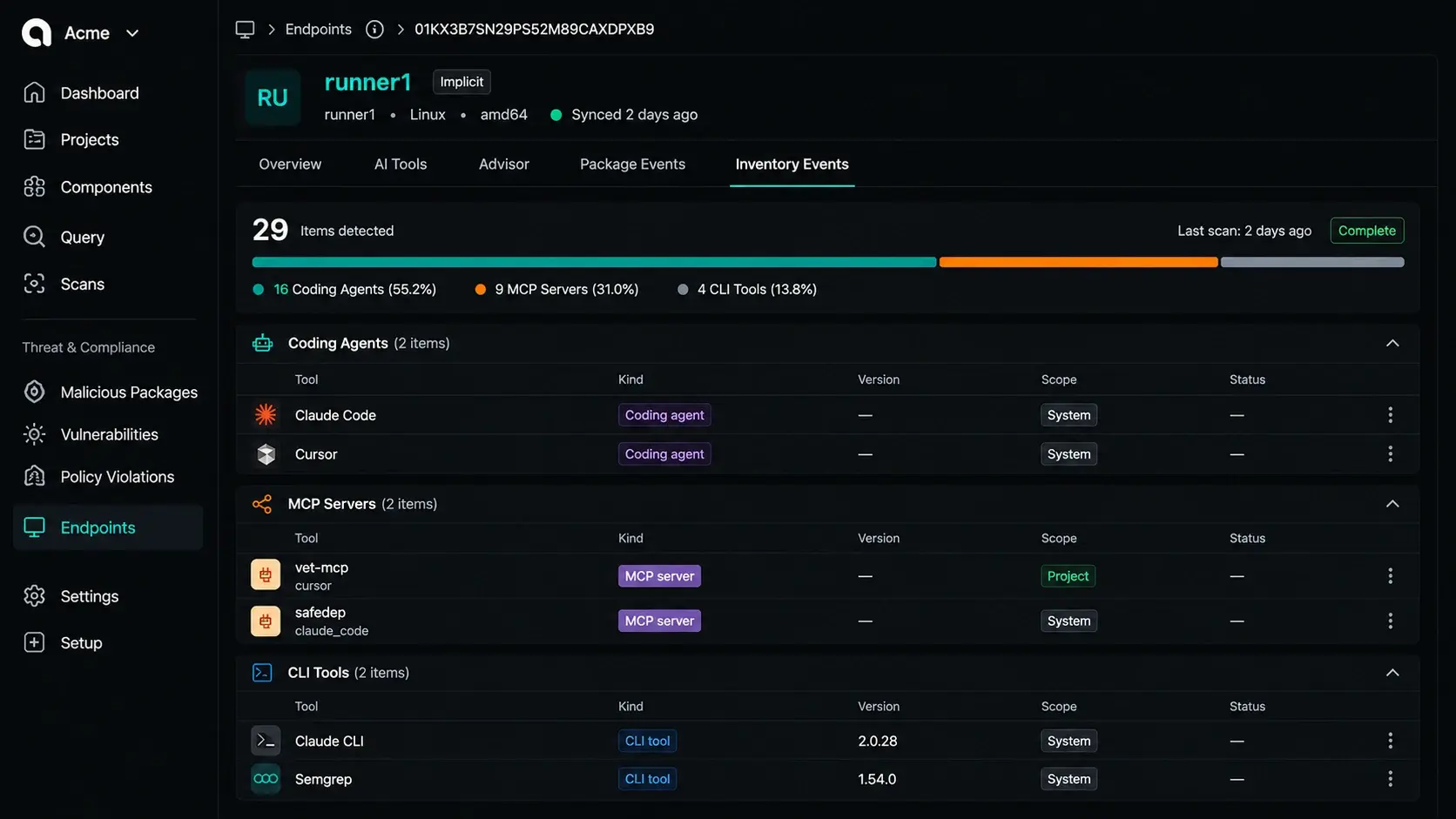
See the AI tooling nobody registered
vet inventories what each machine actually has loaded: coding agents, MCP servers and CLI tools, with scope and version. None of it appears in a lockfile, so none of it shows up in a repo scan.
- Coding agents, MCP servers and CLI tools discovered
- Scoped per machine, per project and per user
- An inventory snapshot, not your source code
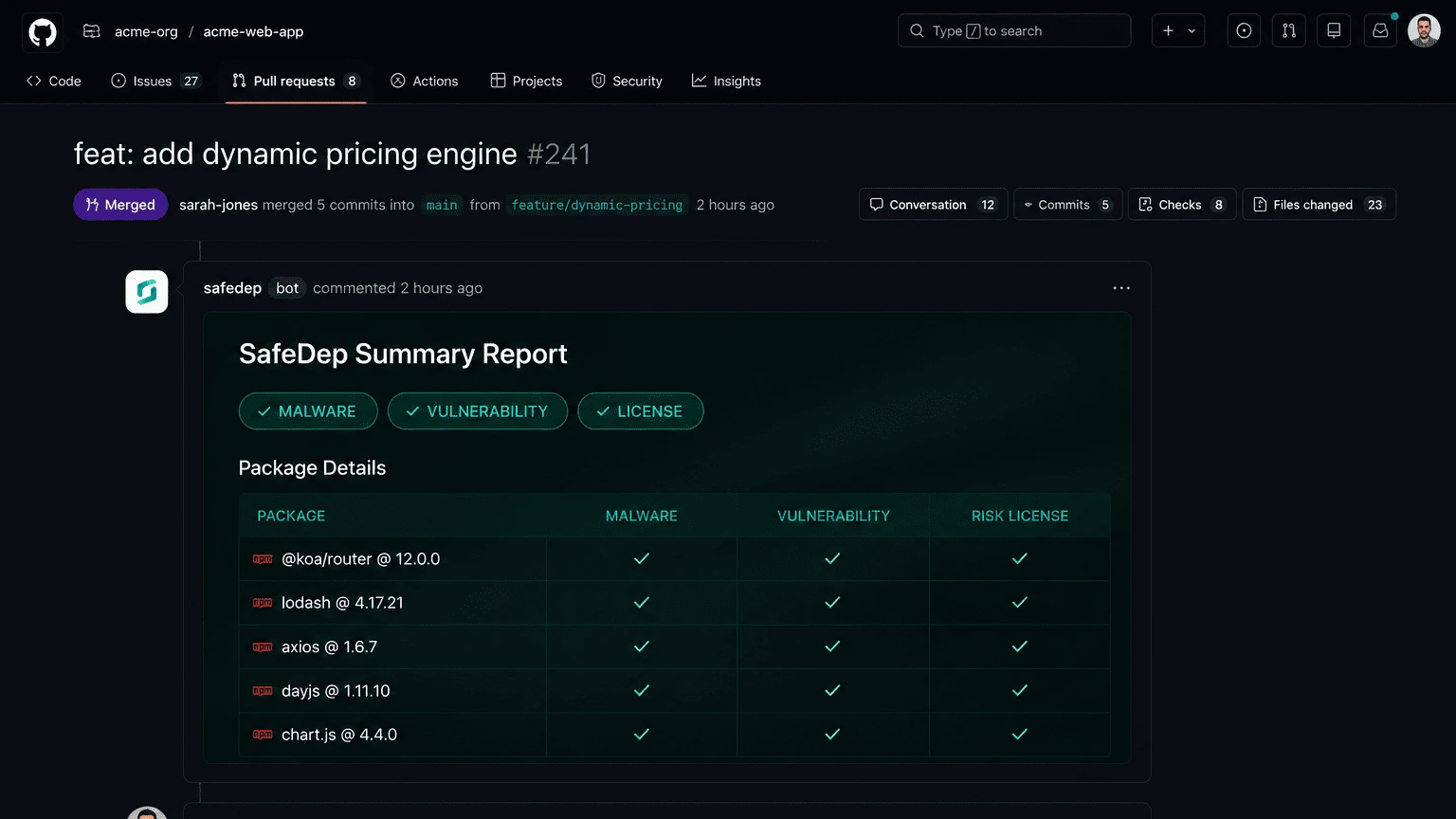
Every dependency reviewed before it merges
The GitHub App posts a summary on each pull request: malware, vulnerability and license checks, with a verdict per package. It runs as a required check, so nothing reaches main unreviewed.
- Malware, vulnerability and licence in one report
- A verdict per package, posted on the pull request
- A required check, so nothing merges unreviewed
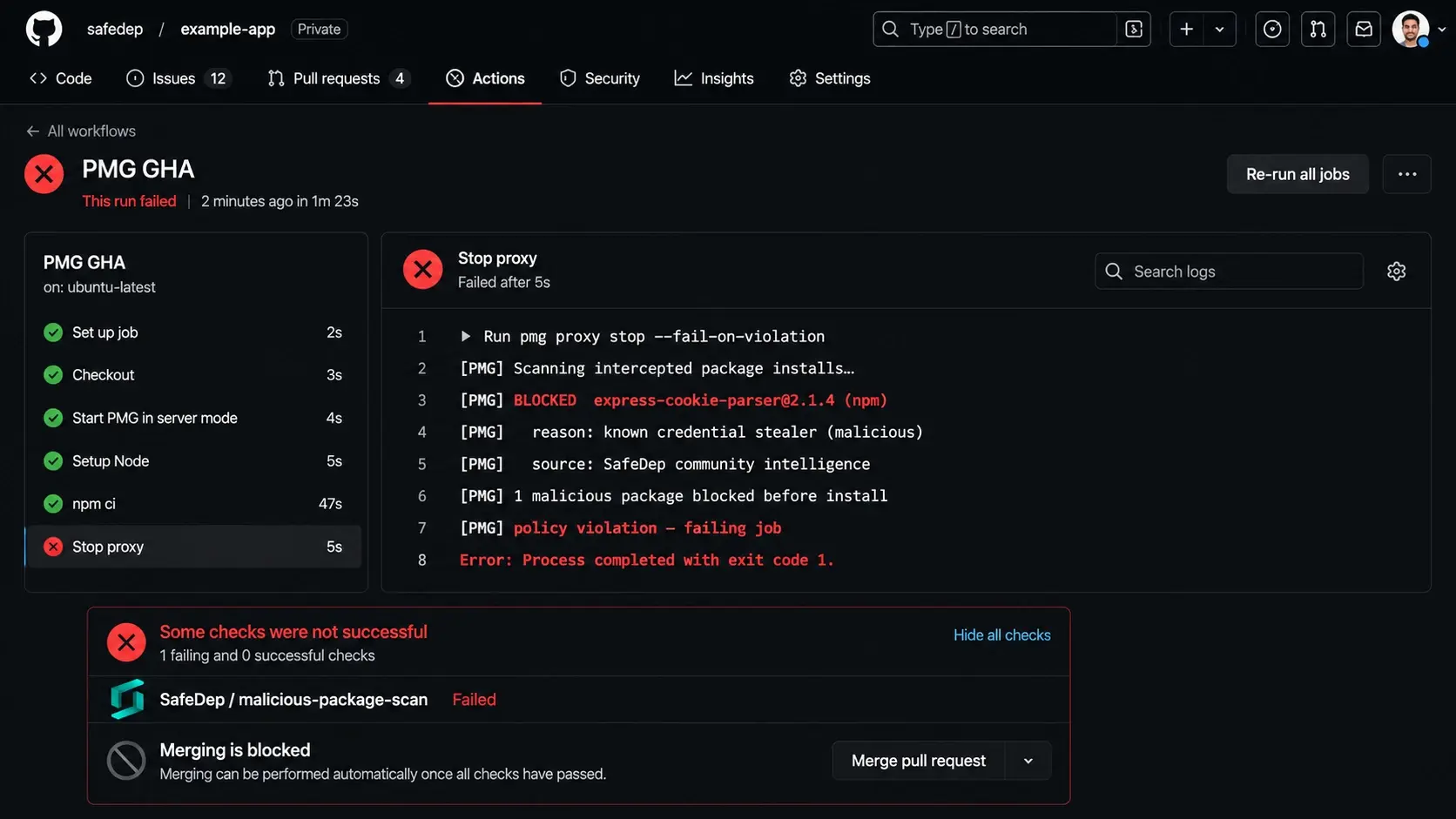
The build fails before the install lands
SafeDep runs as a proxy in the pipeline and intercepts every package install. A malicious package is stopped before it reaches the runner, and the job exits non-zero on the policy violation.
- Installs intercepted, not audited after the fact
- Blocked before it ever touches the runner
- Fails the job on any policy violation
Start on your laptop.
Roll out to the org.
Every enforcement point is open source and auditable, so there is nothing to take on trust. SafeDep Cloud is what turns those same tools into protection for a whole organization.
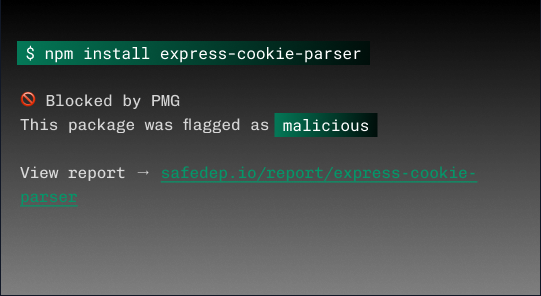
For the individual developer
The command-line tools that do the actual blocking. Free forever, and yours to read.
$brew install safedep/tap/pmg - Block malicious installs on your own machine
- Scan any repo or pipeline with policy-as-code
- Guardrails for your AI coding agent
- Apache-2.0, no account, no telemetry
 View on GitHub
For the security team
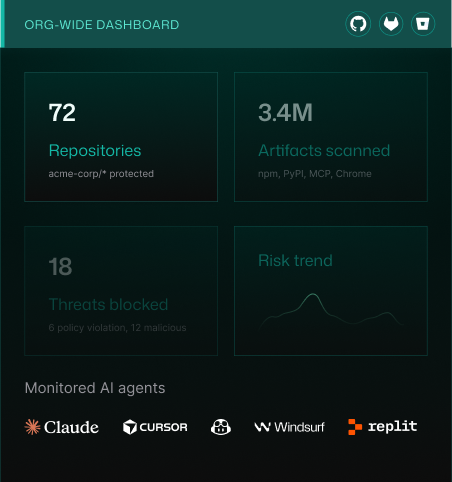
Everything in the open source tools, plus the org-wide layer: which components exist, who pulled them in, what policy blocked what, and proof for the audit.
- One policy enforced at every entry point
- Org-wide inventory and component lineage
- Exceptions, approvals and audit history
- SSO, tenants and role-based access control


Threat research from the supply chain frontline

eMudhra CA Key Compromise: Response Guide for Developers
Anyone can compute eight eMudhra intermediate CA private keys from public certificates. Browsers block the compromised intermediates, but CI runners, containers, JVMs and Go binaries can still trust forged certificates. Test and update affected systems, and decide whether to rotate credentials.
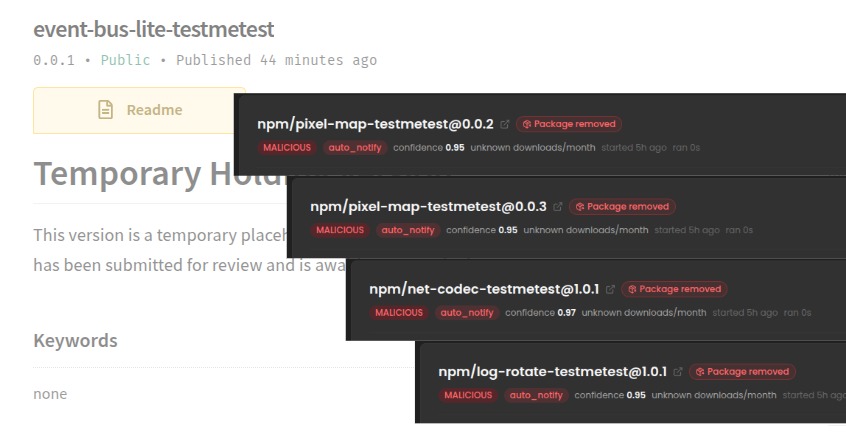
testmetest npm Packages Carry a Miasma-Family Worm
18 npm packages carry a Miasma-family worm that steals credentials, spreads to other packages and installs a wiper. New builds replace the binding.gyp trigger with a native addon.

Compromised LiteLLM 1.107.0 on PyPI Installs a Credential Stealer and Backdoor
Every wheel of LiteLLM 1.107.0 on PyPI installs a credential stealer and a remote code execution backdoor. Both run each time Python starts. The code is not in the upstream GitHub source.

Ship code.
Not malware.
Start free with open source tools on your machine. Scale to a unified platform for your organization.
